Listen On:




Listen On:
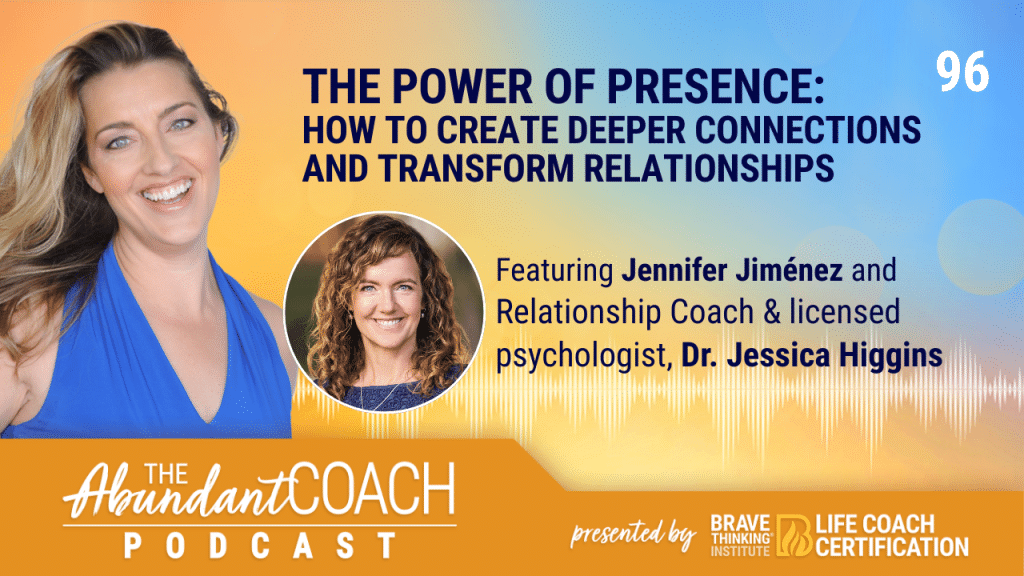
The Power of Presence: How to Create Deeper Connections and Transform Relationships with Dr. Jessica Higgins
00;00;01;12 – 00;00;27;03
Mat Boggs
Welcome to the Abundant Coach. This is a weekly podcast about creating full spectrum success with a thriving coaching business, while making a profound difference in the world. Each week, you’ll discover insights, strategies, and inspiration to help you attract your ideal clients. Create real transformation and grow your coaching business while living your purpose with true freedom and fulfillment.
00;00;27;05 – 00;00;57;15
Jennifer Jimenez
Welcome to the abundant Coach podcast. My name is Jennifer Joy Jiménez, one of the co-founders of the Brave Thinking Institute and trainers within our coach Certification division. It is my pleasure to be your host today. I am so thrilled to have Doctor Jessica Higgins in the house, who also just happens to be my longest time best friend. We’ve been friends for over 40 years.
00;00;57;15 – 00;01;06;20
Jennifer Jimenez
Jess, thank you so much. And Doctor Jessica Higgins, I’m so grateful that you are here. I thank you for being here and supporting us today.
00;01;06;22 – 00;01;14;09
Jessica Higgins
I am so grateful to be here and share this time with you. It’s such a treat and I’m looking forward to our conversation.
00;01;14;11 – 00;01;43;01
Jennifer Jimenez
Yay, beautiful! Well, without further ado, I want to share a little bit about my best friend who is an absolute complete badass, by the way, in the work that she does in the world and the brand that she’s built and how she’s blended. Being a Doctor of psychology with transformational coaching and just being this force for love and connection and relationships in the world, which is her area of expertise.
00;01;43;01 – 00;02;17;01
Jennifer Jimenez
So let me share with you her bio doctor. Jessica Higgins is a psychologist, a coach, a relationship expert with over 25 years of experience helping people break free from painful patterns and create deeper, more authentic connections. She blends psychology with transformational coaching, attachment informed tools and somatic practices to help people not just understand change, but actually experience it.
00;02;17;03 – 00;02;43;06
Jennifer Jimenez
She’s here to share how coaches can bring these same principles into their work, and create safer spaces, stronger client results, and even better enrollment conversations. Not to mention, let me just say their own relationships. So the tools that she teaches and shares in her podcast, which, by the way, is frickin awesome. It’s so good. I highly recommend you check it out.
00;02;43;08 – 00;02;52;22
Jennifer Jimenez
We’ll help you if you have a relationship with a significant other, relationship with your kids, any relationships in general. So first of.
00;02;52;22 – 00;02;53;27
Jennifer Jimenez
All.
00;02;53;29 – 00;03;23;27
Jennifer Jimenez
I just want to say, as we launch and get started, that my best friend, doctor Jessica, put herself through school and that is no small thing. And I’ll just say, if it’s okay, Jess, that school is not her favorite thing. When we were in middle school and high school. So to have this dream to see her and I get like, I’m going to have to keep it together in this podcast because I can feel that the tears might flow already.
00;03;23;29 – 00;03;55;15
Jennifer Jimenez
But to have this dream that required, like really hunkering down and harnessing her school savviness, you know, to get her undergrad, to get her master’s degree, to get her doctorate is just no small feat. Just energetically, intellectually, but also financially. And to see her, I was at her graduation of her doctorate and to hear the, the, you know, the the other doctor.
00;03;55;17 – 00;04;14;27
Jennifer Jimenez
I know I’m probably not saying it right does she could help me out, but to hear them say, doctor Jessica Higgins was so amazing and then but it’s one thing to be able to hang that plaque on your wall, right? Everybody, I think I know so many people who are like, I should go back to school and get my master’s or get my doctorate or whatever, but that’s all fine and dandy.
00;04;14;27 – 00;04;37;15
Jennifer Jimenez
What the real dream is, is what you’ve built, that you take, that training, you take that education and that real world experience in the field of relationships, which is your you have an amazing breadth of expertise in all areas of life, but that’s really your one of your areas of real genius, right, is helping couples and helping relationships thrive.
00;04;37;18 – 00;05;09;01
Jennifer Jimenez
Taking that and turning it into a brand, building a website, reinventing that website. More than once when we’ve been on walks together and we’re talking about, you’re in that reinvention mode and stay up with the times. And then I remember the day when you launched your podcast and you launched your online program, and just and moving from state to state and taking your business with you and being able to blend therapy, but then also add transformational coaching, and now you’re adding retreats to your work.
00;05;09;01 – 00;05;38;25
Jennifer Jimenez
So I’m so proud of you. And I also am proud of you because I, we train and certified coaches, and I know how many coaches want to do that. And people just like you who have massive degrees, they’re multiple doctorates and masters. But building a business is no small thing. So as you think about that history and I’ve just like literally walked us through 25 years or whatever it is of your life.
00;05;38;28 – 00;06;05;16
Jennifer Jimenez
But if there’s somebody that’s struggling to build a business right now where they’d love to leave their day job and go for it, looking back at the young woman who graduated with her PhD, and she’s heading out into the real world to build this thing, if there’s one piece of advice or just just sharing a piece of wisdom around really going for the dream versus going for what’s in their comfort zone, what would you say?
00;06;05;18 – 00;06;06;20
Mat Boggs
00;06;06;22 – 00;06;46;24
Jessica Higgins
Well Diane thank you. I appreciate all your acknowledgment and just affirming the journey. I would actually say that the t brave thinking Institute and the work that you all do are and your genius particularly and helping people really connect with a vision and a dream and being able to hold that through the obstacles, through the challenges and being able to keep moving even when it feels like there’s a setback or an obstacle, and continuing to show off, and that the fruition and the development of it will happen.
00;06;46;26 – 00;07;02;06
Jessica Higgins
And sometimes it may emerge and look different than we’ve or likely better than we would even imagine. But that being able to continue to have that connection, it’s almost this cord or thread and connection to the dream, to the.
00;07;02;06 – 00;07;03;15
Jessica Higgins
Goal.
00;07;03;17 – 00;07;26;18
Jessica Higgins
And believing in it and really having not claiming it almost as it is. It is mine to have. And then the process of getting there and just continuing to know that it’s possible and to do the work and there’s, as you all do, such a brilliant job of helping people negotiate all of the things that might interfere with that belief and that progress.
00;07;26;20 – 00;07;52;26
Jennifer Jimenez
Yeah, I love that. So coming from a vision and making a decision and then being willing to continue to believe even when the obstacles rise up and different things are thrown in, your path, you know, just continue to stay the course and believe in that vision which you’ve done so amazingly. So speaking of obstacles, you know, we know each other’s messy moments, many of them.
00;07;52;29 – 00;08;18;24
Jennifer Jimenez
And which which messy moment in your own life or relationships. Right. Helped or caused that that switch to be flipped on you deciding to help other people or, you know, maybe shift how you coach or change how you show up for clients? Is there like a messy moments story that you’d be willing to be vulnerable and share?
00;08;18;27 – 00;08;50;10
Jessica Higgins
Cause I don’t know. I think it can be distilled to a beginning moment. That then was further refined and continued to develop, and it was a progression of many years that helped me really understand the deeper core principles that were operating in me. So you remember I was dating someone that is not my current husband. It was the relationship that was before my now husband, and we’ve been together since 2006.
00;08;50;10 – 00;09;20;09
Jessica Higgins
So approaching 20 years, come this spring and this relationship prior, we were in this criticism defensiveness loop and I was the one that was defending. And at the time I was operating on the belief that, oh, he’s misunderstanding something. If I could help him understand and explain, he would not feel the challenge or whatever he was feeling.
00;09;20;11 – 00;09;49;02
Jessica Higgins
And what I know now is I was responding to his protest or his fear in the story, rather than being able to really understand his deeper attachment, need attachment, fear or core feeling. So I was meeting him in his coping strategy, which was to be critical when there was an underneath real threat for him and his system. And I was having a very difficult time seeing that.
00;09;49;02 – 00;10;09;12
Jessica Higgins
I think most of us do be able to decode and then be able to respond to the deeper feeling, core emotion or attachment need. So that actually prompted me that relationship did not continue how I know now. I mean, perhaps if I would have applied the principles that I know now, how could it have been a different experience?
00;10;09;12 – 00;10;19;02
Jessica Higgins
That’s kind of a question mark then, and I don’t think it’s really worth trying to, hypothesize. But I will say it’s set me on a journey. Pardon? Yeah.
00;10;19;09 – 00;10;21;28
Jennifer Jimenez
Where you move on the journey of where it took you.
00;10;21;29 – 00;10;22;05
Jessica Higgins
Yeah.
00;10;22;06 – 00;10;57;10
Jennifer Jimenez
I love what you just said. And I can hear some listeners going, okay, give me more. I want to hear the juicy, messy, like give me an example. So you could take us back to the way he’s criticizing and then what your behavior was. If you had known different, you obviously would have responded or did you react? Give us an example of that and then maybe an example now that you I know you’ve coached and then a therapist for literally thousands of people over the last several decades, maybe the most common criticism, because I know criticism is a real hot topic for your clients.
00;10;57;10 – 00;11;07;24
Jennifer Jimenez
And I’m sure it is in lots of listeners of this podcast. There’s either we’re criticizing our spouse or we’re feeling criticized. I’d love to some actual examples, if you wouldn’t mind.
00;11;07;24 – 00;11;47;06
Jessica Higgins
Yes, yes, yes, yes, this is really great to make a little bit more, accessible. So I don’t actually remember the specific things that this person was criticizing me about, but I will describe the pattern. So he whatever the details of the scenario, he was taking issue with something that I said or did or didn’t do. And so I tried to respond with why I did what I did, helping him understand my intentions, where I’m coming from, why I did what I did or why I did what I didn’t do or didn’t why didn’t do what I did.
00;11;47;09 – 00;11;48;16
Jessica Higgins
And yeah.
00;11;48;18 – 00;11;55;17
Jessica Higgins
What I realized is that he felt afraid. He didn’t know that he could trust me.
00;11;55;19 – 00;11;56;20
Jessica Higgins
And.
00;11;56;23 – 00;12;22;23
Jessica Higgins
That my that I was either with him or for him and that I was going to be consistent and reliable and that he could really fully be more open with me. And he came from a background of an alcoholic father, and there was just divorce and conflict. And so I think he he just operated in the world with a bit more armory and was very charismatic and open and social.
00;12;22;24 – 00;12;48;16
Jessica Higgins
But when it came to what was like typically and, from an attachment perspective and adult romantic attachment, that’s where our nervous system basically feels our connection and our survival. Through that connection, we need to be connected. We’re social animals. So when we were little, it’s our primary caregivers, our parents, that give us that sense of security in the world.
00;12;48;16 – 00;13;10;10
Jessica Higgins
And then as we get into adulthood, we still need a safe haven with connection. That’s how we’re wired. And so usually that comes in the form of a spouse or a significant other. So typically the relational, space is where we’re going to get triggered the most. So it wasn’t until later that I recognized, oh, he was afraid.
00;13;10;12 – 00;13;32;20
Jessica Higgins
Had I known he was afraid I could have helped respond to his fear and helped reassure him, helped comfort him in a way that perhaps would have made a bigger difference. I just didn’t know that he was afraid. I didn’t know his threat system was activated and how to support him more. Feeling more regulated, feeling more safe. I was just responding to the content.
00;13;32;23 – 00;13;34;19
Jennifer Jimenez
Yeah, yeah yeah yeah.
00;13;34;19 – 00;13;59;11
Jessica Higgins
So got it. Then the other just to fast forward, I actually have an example with that. This was last year. It’s a personal example. And I can give you client examples for days. But just a personal share. So this was a little over a year ago. My husband and I were at the breakfast table and his sister, youngest sister had lost her significant other.
00;13;59;11 – 00;14;02;00
Jessica Higgins
Her, partner.
00;14;02;02 – 00;14;26;04
Jessica Higgins
And I was sharing with him that I had reached out to his sister and sent a lovely, loving, supportive text. And he seemed to get upset with me or annoyed with me. And I was very surprised. And I was like, I don’t understand. Like, it seems like I did something wrong. And I started to feel that defensive inclination to say, well, here, let me show you what I wrote.
00;14;26;06 – 00;14;55;25
Jessica Higgins
It was quite lovely and kind, and he still wasn’t softening. And again, this was me responding with I didn’t quite understand what was under the inside. So knowing what I know now and it’s harder. I mean, some people are like, oh, you must, but your relationship must be so smooth. And I was like, well, you know, I trust the principles and I can trust the process and I’m able to do the work, but it still doesn’t buffer me or alleviate from feeling my own hurt or my own fear.
00;14;55;27 – 00;15;22;13
Jessica Higgins
It just means I have a little bit more understanding of the process. So luckily, I had enough of my own ability to feel like I could calibrate and get curious. And I was like, okay, so what do I know about the situation? And thinking about them? And I was like, I wonder, is he feeling protective? Because as you know, he’s done a lot around grief work and supporting people in the grieving mourning process.
00;15;22;13 – 00;15;47;17
Jessica Higgins
So I was like, there’s something here. And so I asked him, I said, are you feeling protective of your sister? And he’s like, yes. So I was like, okay, well, that I get like, it’s because I think it was too soon. It was just like this barrage. Like he was worried about her feeling overwhelmed with all these people reaching out, and that perhaps there could have been a little bit more sensitivity and attunement, that maybe she’d need support along the way.
00;15;47;17 – 00;16;10;15
Jessica Higgins
And just to give a little bit of space. So still don’t think I did anything wrong. And yeah, I could bond with him around. Oh, you’re feeling protective of how fragile or, you know, just shocked because it was a slightly anticipated but very sudden. Yeah. So that’s an example where I did my best to tune in to what was going on on the inside.
00;16;10;15 – 00;16;21;25
Jessica Higgins
And that helped. It would have been I would have preferred him just say, I’m feeling protective and and give me the signals to help me understand where he was on the inside. But that’s a that’s a short example.
00;16;21;29 – 00;16;23;06
Jennifer Jimenez
Yeah.
00;16;23;08 – 00;16;32;06
Jennifer Jimenez
Well, what I loved there was a couple things I love the whole story and the just the awareness that oftentimes when our significant.
00;16;32;06 – 00;16;33;01
Jennifer Jimenez
Other.
00;16;33;03 – 00;16;58;14
Jennifer Jimenez
Is reactive. Right. They’re coming in and they’re complaining or they’re criticizing or they’re they’re not responding in the way we feel we should be quote unquote, responded to or it doesn’t seem logical, right, that this wouldn’t equate to that. Right. Number one is super, super helpful. What you shared, which is turning up your curiosity. It doesn’t mean that we’re immune for being human.
00;16;58;14 – 00;17;23;23
Jennifer Jimenez
We’re human. Somebody responds in a certain way where we feel criticized, or somebody is not responding in the way we think should be, you know, in that moment, just to pause. You know, certainly if we notice we’re getting triggered or we’re getting defensive to say, not let me pause. Let me turn up the volume of my curiosity that isn’t always so easy to remember to do, but when we do it creates a whole different energy.
00;17;23;23 – 00;17;42;28
Jennifer Jimenez
It’s one of the things we’ve been, and I know you teach this all your clients. We’ve been endowed with this ability to in our brave thinking, at terminology, we say, notice what we’re noticing. It’s metacognition to be able to be in a scenario or a situation and sort of rise above, get curious and just see what else is going on here.
00;17;43;00 – 00;18;06;08
Jennifer Jimenez
And just that alone. Not all of us have the kind of education you have just to be able to go, oh, he’s being protective. And, you know, I mean, there’s just you have the storehouse of knowledge and expertise and information and education that you can pull from. But that’s where therapy and coaching comes in. Quite honestly. You know, we can’t see the picture when we’re the one in the frame.
00;18;06;10 – 00;18;30;06
Jennifer Jimenez
So that’s why having a coach like I know you have people mentors, coaches, therapists that you’ve worked with over many, many years and continue to work with so do-I so the best coaches that I know and therapists and psychologists are doing the work themselves because we can’t we just we all have blind spots. So if you’re wondering, how would I ever see that myself?
00;18;30;06 – 00;18;52;03
Jennifer Jimenez
Just know that oftentimes we can’t. That’s why it’s so helpful to take, you know, these kinds of situations to someone outside of ourselves or have a best friend like Jess. You can call and be like, okay, here’s this going on. Can you give me your $0.02 on this? Or just sometimes, quite honestly, and you and I were talking about this the other day, even if you don’t offer feedback, just saying it out loud.
00;18;52;03 – 00;18;59;23
Jennifer Jimenez
Outside of my own head can be so helpful. Just calling your friend, you know, so you can see really.
00;18;59;26 – 00;19;22;25
Jessica Higgins
Well, I think to that point, this is where a new system can emerge, because if we’re in our tendencies and in our patterns, and I would say our protective patterns, because we learn these in life and they were an adaptive response, they actually served us really well. We honor them and love them, and they perhaps keep us in a particular dynamic.
00;19;22;25 – 00;19;47;11
Jessica Higgins
And any couple bind you have a particular dance, and unfortunately people’s protective strategies are often very different. So one classic you asked about clients and what’s common. You have the distance and the pursuer. So even in the criticism defensiveness loop you can see one is actively approaching the other with complaint or criticism. That tends to be a little bit more of the pursuer.
00;19;47;18 – 00;20;10;08
Jessica Higgins
Then you have the one that is distancing or pulling back a little bit, or trying to just keep things calmer. So typically the one that has the protective strategy of questioning, I tend to have had this tendency more in my past because it it’s not always the case, but it tends to correlate with an anxious attachment style, which is I’m not quite sure everything’s okay.
00;20;10;08 – 00;20;37;04
Jessica Higgins
Let me check. Let me keep tabs. Can even look like hyper vigilance or tracking. But there’s this sense of questioning to try to see where the other person is at. Now, where this gets confusing. To your point around if we can send a clear signal that’s a bit more vulnerable and connected to the deeper state of either the attachment, fear or the longing, then that’s a different conversation.
00;20;37;04 – 00;21;01;06
Jessica Higgins
But if we approach with the protective strategy, it’s almost like this deeper feeling is there, but we’re not acknowledging it. We’re coming at it, at it from a different angle, and it’s more safe. It feels more safe. But the person on the receiving end is just feeling that criticism. And if they have a propensity to feel again, this correlates a little bit more, not always with the more avoidant tendency.
00;21;01;06 – 00;21;26;02
Jessica Higgins
And that’s where, oh, I somehow let you down or I disappointed you or I’m not enough. So if there’s the interpretation of our partners giving us evidence that we’ve somehow let them down, it’s kind of like, oh, I’m going to back away from that because it’s not to be trusted. And there’s a little bit more of like in life, my better move has been to rely on myself or to go independently because it’s not.
00;21;26;02 – 00;21;44;25
Jessica Higgins
I haven’t always gotten a good experience or a safe responsiveness in in the dynamics. So then you could see how this would escalate. The one that pursues is looking for a response. The one that’s distancing is like, ooh, that’s scary. Let me kind of get away and then the one that’s like, well, I want to know where you are.
00;21;44;25 – 00;22;13;04
Jessica Higgins
Are you there with me? And fear of abandonment, I’m sure. Then feels more distance, then gets louder to hopefully provoke a little bit more of that sense of connection, or you’re there with me and that responsiveness. But again, we’re not asking for. We’re not sending the clear signal of to your point, oh, I’m feeling nervous, or I feel a little scared that maybe you’re not into this as much as I am, or that you’re not with me.
00;22;13;06 – 00;22;36;25
Jessica Higgins
That’s a different signal then the criticism or the complaint. And that typically allows some more and a little bit more safety to respond to. So it can have a huge, profound effect on changing the relational pattern and the dynamic, because then that gives people an opportunity to show up for each other, feel that sense of responsiveness, and ultimately have each other’s back.
00;22;36;28 – 00;23;22;29
Jennifer Jimenez
Yeah. So good. I just I just appreciate when, you know, in relationship there’s open communication where like if you’re feeling triggered or I’m feeling triggered to say I’m feeling a greater response than maybe what this moment calls for. I’m not exactly sure why, but just so you know, you know, super trigger and just be like, really transparent or if you’re the one who triggered the other, you know, even though you might be feeling like they’re overreacting or there’s no way that what they’re saying is true, but just to acknowledge, I think the number one thing that I have stretched myself to learn how to do and not perfectly, but I seek to do it better
00;23;22;29 – 00;23;47;20
Jennifer Jimenez
and better, is if and when somebody is approaching me with something that they want to share. It might be uncomfortable. Before I go into defending why or, you know, whatever it might be, that what might be my knee jerk reaction is just to repeat. What I hear you saying is, it can be so hard, especially if you disagree with what they’re saying.
00;23;47;22 – 00;24;27;12
Jennifer Jimenez
It feels exaggerated or you don’t understand it, or it feels hurtful is just to neutralize turn of your curiosity, right? And just say, okay, just because I’m going to acknowledge doesn’t mean I fully agree. But let me just acknowledge you can even start with that. You know, I don’t always do that anymore, but just because, you know, it feels good to say that, but to say so what I hear you saying and then really repeat word for word, even if they’ve yelled or they’ve said words that you don’t agree with her appreciate or labels like could be really strong or just even hearing those words word for word back to them.
00;24;27;12 – 00;24;49;22
Jennifer Jimenez
It just like it. It totally diffuses and neutralizes in my experience, the whole thing. But it takes a lot of self-discipline, I will say, especially when we feel heated in the moment. But there’s just something really magical. Most people and I know, you know, I’m preaching to the choir, but they want to feel heard. They want to be in, they want to feel acknowledged.
00;24;49;25 – 00;24;58;27
Jennifer Jimenez
And in that criticize or and criticism loop. There’s just a can really, you know, create a lot of defensiveness. So.
00;24;59;02 – 00;25;19;19
Jessica Higgins
Well, I just just to kind of acknowledge I think it does give an opportunity to slow things down, which are nervous systems, again, using that kind of nervous system response here, if we’re feeling at all threatened, that just tends to rev up and turn up the volume. So being able to just help organize, slow things down and bring focus.
00;25;19;21 – 00;25;47;19
Jessica Higgins
Because if the focus is about oh, so you’re bringing up something here, let me see if I understand, then that gives a little bit more path to that curiosity and then the invitation to have more understanding. So then we can kind of access the deeper layers. And that’s typically what’s fueling it. But I can work classic to your point, as humans going, I mean, we have these brains that we interpret, perceive and have meaning making.
00;25;47;21 – 00;26;10;02
Jessica Higgins
And often we’re wrong. Like I have one example, like a couple years ago, my husband, we were at again, this is another table example. I think we were it was after dinner and we were sitting chatting, and I was sharing something that I felt like mattered to me. And he was looking away. And I’m like, you know, I know he cares about what I’m saying, but he’s just overtly looking.
00;26;10;02 – 00;26;30;19
Jessica Higgins
And I don’t know if you’ve ever tried this exercise, but talking to someone who’s actively looking away, it’s difficult to keep talking because it doesn’t seem like they’re that interested. That’s exactly. And so I was like, I did kind of that it’s not comfortable to do, but is a bit of the vulnerability of showing, I guess, showing the analogy of showing my belly.
00;26;30;21 – 00;26;49;01
Jessica Higgins
And I was like, I’m worried you’re not that interested in what I’m saying. You’re looking away. And he’s like, I don’t want to breathe on you. He had a cold. And so he was trying to look away. So he wasn’t breathing because we were in close proximity. And I was like, oh, well, that’s really sweet. Thank you.
00;26;49;03 – 00;27;06;07
Jessica Higgins
But this is how typically, because typically couples are fighting about it’s not something big. It’s like, oh, you didn’t take out the trash or you know, you forgot this thing and the meaning making around it. And that activates our threat system. And often we’re not talking about those threats. We’re talking about the content.
00;27;06;10 – 00;27;30;07
Jennifer Jimenez
Yes. So good, so powerful. Well, speaking of nervous system response, when you’re in a session with the client and you can see that they’re just like really up in their head and you want to invite them into their heart and really into opening up into a space of vulnerability. Do you have like a 60 or an hour? Doesn’t have to be 60 or 90s, but just like a power tool that you use, the parts that that you could share.
00;27;30;09 – 00;28;09;09
Jessica Higgins
Well, there’s two that come up. One would be asking them to notice what’s happening in their body and just the sensation and just what they’re experiencing. And combined with I might even do the second tool that I’m offering first, because I think that starts to access something deeper. And it’s a simple question. So they’ve got their story, they’ve got all their evidence to support their story, why they have a right to feel or they’re justified to feel the way that they do and they’re asking for something or taking issue that the thing that they want didn’t happen.
00;28;09;09 – 00;28;31;06
Jessica Higgins
So if I can help them look at if you were to get the thing that you’re asking for, because I’m working in a couple dynamics, so it’s like he did or she did or, you know, various and if you were to get what you’re wanting, what would that allow you to feel? And it helps them connect with what really matters and the significance.
00;28;31;06 – 00;28;58;16
Jessica Higgins
So typically brings a bit more connection to what they’re the the again, the deeper need is and that tends to soften because that’s what really matters. Yeah. And even helping them access okay. Can you tell me a little bit more about what you’re feeling right here, right now in this moment experientially. And again that can help them feel a bit more experientially.
00;28;58;16 – 00;29;01;09
Jessica Higgins
And that gives a little bit more opportunity to.
00;29;01;12 – 00;29;29;05
Jennifer Jimenez
Yeah, I love that. I’m going to use that with my husband to get what you’re wanting. How would you feel versus what do you want. Yeah. Is it takes you into a much different state. Like it immediately turns on my soma, like my felt body sense of, oh, but what I feel I would feel safe. I would feel loved, I would feel acknowledged, I would feel seen or whatever, whatever that is.
00;29;29;05 – 00;29;33;13
Jennifer Jimenez
So I love that. So good, so good, so good.
00;29;33;16 – 00;29;48;19
Jessica Higgins
And the significance and the meaning. So some people don’t always respond to how do I feel? But it’s accessing how this matters. Tell me how this matters or what there’s value in this for you. Can you tell me more about how this is so meaningful for you?
00;29;48;21 – 00;30;07;11
Jennifer Jimenez
Yeah. So good. So, so powerful. Because then because we get so caught up in the details, don’t we? Like. Well, it was this time of night. It was 9 p.m.. No. Is 830. No, it’s nine, you know, and it’s like it that’s not it really doesn’t matter what time it was, you know, that’s a silly example. But it it’s true.
00;30;07;13 – 00;30;32;16
Jennifer Jimenez
True. It’s true. So okay, this leads me to my next question, which I really love, which is we all have myths about what a good relationship is, right. What is it? What does that even mean? What’s a good relationship? So if you think about all the couples that you’ve, you know, worked with and supported and what would be the number one myth that most people have or come in with that?
00;30;32;16 – 00;30;37;16
Jennifer Jimenez
You think, if we could just drop that myth, we’d all be much better off?
00;30;37;18 – 00;30;39;00
Mat Boggs
00;30;39;03 – 00;31;09;01
Jessica Higgins
I think that it is about expecting that romance staged to sustain that. It’s usually typically 9 to 18 months of this very bonded, neuro chemically infused, high and that it’s supposed to be easy, that this connection and that if you have the right partner, it’s supposed to be easy. Now, I’m not saying that love isn’t perfect. The essence of love is perfect.
00;31;09;01 – 00;31;45;17
Jessica Higgins
And as humans who have lived different experiences have different wounds, sensitivities and meaning making that we are then prompted with the challenge of negotiating how to support a win win or having dynamics that feel mutually beneficial. And typically that takes some level of negotiating and being able to collaborate, and that cultivates intimacy. But I think we feel the threat of conflict and labeled that as problematic.
00;31;45;17 – 00;31;56;25
Jessica Higgins
Our partners, something’s wrong with our partners. Something’s wrong with me or us. Hence, we just don’t address the conflicts or we dissolve the relationship. That’s usually where people get stuck.
00;31;56;27 – 00;32;28;13
Jennifer Jimenez
Amazing. So true, so so so true. Yeah, I, I don’t disagree and I think I would underline what you’re saying in that oftentimes what I hear from the women that I coach in the work that I do is that my partner’s responsible for my turn on or responsible for making me feel a certain way versus really recognizing that that’s my responsibility, you know, not that they’re, you know, certainly it’s co-creative.
00;32;28;13 – 00;33;04;21
Jennifer Jimenez
And there are ways that we can both take 100%, 100% responsibility. But, the more turned on by life, I am doing the things that light me up and bring me joy. I’m naturally in a lit up, joyful, happy, quote unquote turned on space in my divine feminine. And when I was unhappy with the work I was doing, burned out living on fumes, you know, and not taking care of myself there, I couldn’t have been further from feeling sensual and romantic and wanting to be intimate and all of those things.
00;33;04;21 – 00;33;36;27
Jennifer Jimenez
So I think that’s so key. And, how important it is that, you know, do that for ourselves. So I want to change the subject just a little bit and talk a little bit more about business building, because this is an amazing community of difference makers and change agents. Some of whom are, you know, highly successful and looking for additional tips, others that are just kind of longing and peeking through the window like, oh, I’d love to, you know, be a difference maker and make it a business.
00;33;36;27 – 00;33;59;09
Jennifer Jimenez
So you have done such an amazing job of building that lab top lifestyle where you can do this work from anywhere in the world. You just came off of a couple of years where you and your husband literally went from state to state, exploring and adventure and seeing where you wanted to, you know, settle down and buy a home that I watched you.
00;33;59;09 – 00;34;16;02
Jennifer Jimenez
I’m like, where are you now? I don’t even know. Like it’s like, I have no idea. They were just like all over the the map. It was so cool and amazing to witness just through things in storage and went on this incredible adventure all the while though. So check this out. How many years have you had your podcast?
00;34;16;02 – 00;34;17;00
Jennifer Jimenez
Now it’s like.
00;34;17;02 – 00;34;18;28
Jessica Higgins
It’s ten years.
00;34;19;00 – 00;34;47;05
Jennifer Jimenez
Oh my god. Oh my gosh, that’s amazing. Weekly episodes of building this platform. And I remember a decade ago when you and I were sharing our own woes about building a website and building this online presence, and we were both deciding, okay, what which kind of marketing method do we want to hang our hat on? And my brother was choosing YouTube and doing YouTube videos.
00;34;47;05 – 00;35;01;25
Jennifer Jimenez
And I just remember one day we were having a conversation. You were like, I think I’m going to do a podcast. I’m like, ooh, that would be great for you. That would be amazing. It’s just consistency. Just, you know, it’s one thing to tell somebody or for that person to tell me, okay, we’re going to be consistent. We’re going to do this thing.
00;35;01;25 – 00;35;31;27
Jennifer Jimenez
It’s a whole nother thing to say the least, to build it and then really nurture it for as long as you have. Like it’s a mazing. So for anyone and by the way, it’s never too late. I know I talked to a lot of coaches that are like, oh, there’s way too many podcasts, there’s too many. I don’t, I disagree, I think there’s never been a better time to put out into the world what you feel inspires you, what you feel matters.
00;35;31;29 – 00;35;52;26
Jennifer Jimenez
So I’m curious, like for somebody that’s either doing a podcast now but would love to know how to do it better, or for somebody that that is their dream to really have their voice be heard. What early mistake did you make, that you would love podcasters to know about? And maybe not me?
00;35;52;28 – 00;35;53;27
Mat Boggs
00;35;53;29 – 00;36;24;20
Jessica Higgins
I did everything myself for years, editing the audio, doing all the transcribing. I actually, I don’t think I did transcripts, but the show notes and it was like full on article and the quote graphics. It was a tremendous amount of work and getting a team, although it’s an investment for sure that there is support, because even in the first, I would say, I don’t know if it was like 175 episodes.
00;36;24;20 – 00;36;50;04
Jessica Higgins
I was delivering the content. Now I primarily interview other relationship experts in the field or out there somehow. Can support the understanding of relationship principles by creating the content or the episode, and then doing all the heavy lifting of producing it. It was it was a lot. So there’s so many talented people that are able to support and creating a team to do that.
00;36;50;04 – 00;37;14;15
Jessica Higgins
All the things I think is really worth the investment because as you said, it is about consistency. I had heard that over and over again from business coaches, because oftentimes with content marketing, which podcasting and other marketing modalities are, that it is often the long game. I mean, sure, people get lucky. I read my husband did some SEO and some articles and they just have done so, so well.
00;37;14;15 – 00;37;40;02
Jessica Higgins
So SEO is important too. I think that that can be a boost. All that being said, oftentimes it’s a long game of being consistent and just being in service of what you would love to share and making a difference that that in itself will attract and you’ll, you’ll you’ll learn and grow as people connect with the network. So yeah, it’s the consistency is huge.
00;37;40;05 – 00;38;03;04
Jennifer Jimenez
Consistency and support. I hear you saying that’s amazing. All right. Last and final business question. And then we’ll end on like just, you know, some some fun advice. But of all the things that you’ve done, I know this might be challenging to answer, but is there one thing that, like one needle mover that really supported your business growth over the years?
00;38;03;04 – 00;38;22;18
Jennifer Jimenez
Like if there’s one thing you know, okay, I can attribute clients finding me or really being able to succeed and having a consistent flow because that’s really the biggest challenge. I think for most people who launch a business is consistency, consistent new people coming into your practice, being people, being able to find you, all of that.
00;38;22;21 – 00;38;49;07
Jessica Higgins
I would say being able to create a business that is aligned with one’s personality, what they would enjoy, because that’s going to allow it to be that much more sustainable, that it’s it’s congruent with what if I’m using myself in this example, I like to talk to people like that’s something that I very much enjoy. You know, you mentioned getting through all the graduate programs.
00;38;49;07 – 00;39;11;14
Jessica Higgins
I think I have some ADHD and I’m pretty certain I’ve never been officially diagnosed, but I’m pretty sure I have some dyslexia and I’m like, oh, that, that makes sense. Why it was so hard. So I that’s writing like I can do it, but it’s not something that I very much enjoy and it’s not really that congruent with my personality.
00;39;11;17 – 00;39;24;18
Jessica Higgins
So being able to choose motive or modalities that fit, that feel like you can enjoy doing. And I think that done provides more of that runway.
00;39;24;20 – 00;39;45;01
Jennifer Jimenez
Yeah. So good, so important. Like, what do you love? What do you want to actually be doing? You know, do you want to be talking to people all day. Do you want to be doing more writing? Like for me, I love movement. So I’ve incorporated somatic and conscious movement into my work because it’s what lights me up. It’s what I want to be doing.
00;39;45;01 – 00;40;09;08
Jennifer Jimenez
So I think that’s really super easy. And to recognize you, can you get it’s your business, you get to make up the rules. So if you want to bring art into your sessions because you love art, do that. You know what I mean? Like like like there’s no hard, fast rules. I think we get to dream it up and bring it to life in ways that feel really life giving.
00;40;09;08 – 00;40;34;21
Jennifer Jimenez
I think that’s super, super important and key. So what is your I know before we go there I would love for you to share. Like if people want like they’ll say they want couples counseling or therapy. I know you probably have a waiting list right now, but I know you do retreats. You’ve got you’ve got online. There’s a criticism program that I think if you’re stuck in a criticism loop, people could check out.
00;40;34;21 – 00;40;41;07
Jennifer Jimenez
So what’s your website? What’s your podcast? I don’t know if you have like a free gift or something you want to give, but yeah.
00;40;41;09 – 00;41;12;21
Jessica Higgins
Yes yes, yes, the website is Doctor Jessica higgins.com. That’s doctor with the Dr.. There. You’ll find all of the resources. The podcast is also up on the website. But you can also find it on any podcast player. And the podcast is empowered relationship. And they’re we’re approaching 500 episodes, which is exciting. And then I do have a gift, as you mentioned, shifting out of that criticism into more connective communication.
00;41;12;24 – 00;41;38;21
Jessica Higgins
There’s a free gift, and people sound a lot of value around how to reverse engineer, to really set up conversation more for connection. And it has to do a lot with what we’ve talked about here today. And it’s like 22 examples of what might be a critical lead or a startup and how to shift into like what that could look like, addressing a need or making that more vulnerable, that sending that signal so that I can give you the free gift for that.
00;41;38;21 – 00;41;39;26
Jessica Higgins
And.
00;41;39;28 – 00;41;41;21
Jessica Higgins
Yeah, yeah.
00;41;41;24 – 00;42;18;26
Jennifer Jimenez
Awesome. So we’ll put that in the show notes, the link to all of what Jess is saying, her amazing website, her, amazing podcast, which I highly recommend you check out. And then, the beautiful free gift around shifting criticism into creative and connective communication. That’s amazing. So what’s one final if we just tap in Jess and just or Doctor Jessica, I know, my childhood connection to you turns into way I normally speak to you, but what’s one final word of wisdom or just download that spirit has?
00;42;18;26 – 00;42;36;04
Jennifer Jimenez
If you connect to the beautiful souls who will be connecting to this, you know, episode. And they’re in relationship, of course, with themselves, with their significant other, with their clients, we’re just something that is downloading for you to share. What would you like to share?
00;42;36;06 – 00;43;06;20
Jessica Higgins
I want to emphasize how valuable being present in the deep listening space and what can come from not even if we want to put our agenda on an interaction, or even what we might think we might want in business. I’m deeply listening. I can feel the spirit nudges and that can assist me and my next best move, when I may feel overwhelmed or may think I have an idea around what’s going to be best.
00;43;06;20 – 00;43;30;13
Jessica Higgins
But if I can really listen deeply, I feel like I’ll get those intuitive spiritual heads. And then also, if I can slow down and listen my husband is a bit more somatic or a bit more body oriented, and I’m more verbal. So if I’m not conscientious, I can fill up space through talking and you’ll meet me in conversation.
00;43;30;13 – 00;43;59;06
Jessica Higgins
But at times there can be such value if I just slow down and like, listen with other parts of my being. Like, listen and watch his body, or just give him more room and what he’ll say and what will come up if I’m really holding that listening space and then even with clients or people that I’m interviewing, if my goal is to really attuned to them, see them and hear them, typically that supports a much richer interaction.
00;43;59;09 – 00;43;59;22
Jennifer Jimenez
That’s so.
00;43;59;22 – 00;44;00;28
Jennifer Jimenez
Good.
00;44;01;00 – 00;44;26;29
Jennifer Jimenez
It’s so true. And I would say specifically, I’ll just underscore being a woman, I’ll speak for myself. I’m very verbal. So I love what you said about just slowing down, pausing, watching his body language. And it can be your kids, you know what I mean? It can be anybody, right? Anybody. We’re interacting with. And I will say Jessica is a master at that of all the people.
00;44;26;29 – 00;44;49;15
Jennifer Jimenez
And I’ve got a lot of really amazing masters in my life. But there’s like, no one who listens better than you. You’re just press and you are, you’re you are and I it’s an it’s not an it’s not an intellectual feeling that I get from you. It’s a presence. It’s like to your point, I feel like you’re listening with your whole body.
00;44;49;17 – 00;45;16;18
Jennifer Jimenez
And there’s like this openness of your heart. There’s just this receptivity. And you do a really lovely job of repeating pieces of what I’m saying. And offering space, not just filling up the space with your feedback or whatever, but just holding a beat. And now, granted, you’re highly trained in it as well. You come with some, but you just you’ve cultivated it.
00;45;16;18 – 00;45;37;11
Jennifer Jimenez
It doesn’t just happen. It’s a it’s a cultivating. And so I’ve grown a lot in this space myself. And you’ve been a great, amazing teacher, to feel what it feels like to be held in that. So I attempt to do that in my, with my kids and my spouse. And, you know, I mean it to your point.
00;45;37;11 – 00;45;56;04
Jennifer Jimenez
I love what you said about being able to hear the nudge from that still small voice. And even when you said it, I felt myself drop in and go, yeah, getting quiet so that I know which direction to take next and to feel that nudge. So I love, love, love, love, love that golden nugget and.
00;45;56;04 – 00;46;00;10
Jessica Higgins
Get it and repeat it and remind myself over and over again.
00;46;00;12 – 00;46;03;28
Jennifer Jimenez
How.
00;46;04;00 – 00;46;05;05
Jennifer Jimenez
That’s so good to hear.
00;46;05;05 – 00;46;32;11
Jennifer Jimenez
Because even Doctor Jessica Higgins with many decades forgets her own best advice. But, you know, I think that’s a great, final piece to end on is just that no one’s perfect. We’re all doing the very best we can to to provide that compassion and that curiosity to ourselves pointed at ourselves, knowing that each day, in every way we’re growing and we’re getting better and better and we can learn from each other.
00;46;32;14 – 00;47;08;28
Jennifer Jimenez
So a final just beautiful thank you, thank you, thank you, Doctor Jessica Higgins and my BFF Jess for over 40 years. You’re so busy. There’s a whole waiting list of clients wanting to work with you. I’m so grateful that you carved out the time to bless us with your presence, with your love, with your wisdom. Thank you, thank you, thank you listeners, if you have loved the tools that Doctor Jessica shared with us today, imagine having a proven system to grow your own coaching business with the same kind of confidence and clarity.
00;47;09;05 – 00;47;44;23
Jennifer Jimenez
That is exactly what you’ll get inside of what we call the Life Coach Accelerator, which is our free five day challenge designed to help you start building the business you’ve been dreaming about. And you can join us today at bti.com/5 the number five D as in David C as in cat podcast BTK com forward slash 5DC podcast. You can find the link in the show notes as well.
00;47;44;25 – 00;48;06;11
Jennifer Jimenez
I have heard many of our coaching clients talk about starting with us in that five day challenge. It’s inspiring, it’s motivating, it’s supportive. There’s some really incredible tools. So I highly, highly, highly recommend you check it out. Thank you so much for being with us today. We’ll see you soon. Bye for now.
00;48;06;14 – 00;48;25;28
Mat Boggs
Thanks for joining me this week on The Abundant Coach. To dive even deeper. Visit our website at BTI Dot com slash Coach Certification. If you loved today’s episode, be sure to subscribe on iTunes, Spotify, or wherever you listen to your favorite podcast. And while you’re at it, please rate and review. I’ll see you in the next episode.
Authentic connection is the heartbeat of transformation — in love, life, and coaching. In this heartfelt and wisdom-packed conversation, The Abundant Coach welcomes Dr. Jessica Higgins, a licensed psychologist, transformational coach, and host of the Empowered Relationship podcast. With over two decades of experience guiding individuals and couples toward deeper intimacy, Dr. Higgins shares how understanding emotional awareness in relationships unlocks true connection, safety, and healing.
Through raw personal stories and professional insights, she reveals:
- How to move from reactivity to curiosity when conflict arises
- The hidden attachment patterns that fuel misunderstanding
- Practical ways to calm the nervous system and create safety for vulnerability
- Why deep listening is one of the most transformational tools — for both relationships and coaching
Dr. Higgins’ approach blends psychology, somatic wisdom, and coaching principles to help people not just understand change… but experience it. Whether you’re helping clients navigate emotional blocks or improving your own relationships, this episode is a masterclass in compassion, communication, and conscious connection.
Understanding Emotional Awareness in Relationships
Dr. Higgins opens by sharing how her own “messy moments” in love revealed the real work of awareness — recognizing emotional triggers as protective patterns rather than personal failures. She explains how criticism and defensiveness often hide attachment fears and how decoding those patterns can lead to powerful healing.
Key concept: Most relationship conflicts are not about the content (who’s right), but about the connection (who feels safe).
The Loop of Criticism and Defense
Jennifer and Jessica dive deep into one of the most common relational traps — the “criticism-defensiveness loop.”
Jessica describes how couples (and clients) often get stuck reacting to each other’s protective strategies instead of addressing what’s really going on underneath. She offers a step-by-step example of how she shifted from defensiveness to understanding in her own marriage by identifying the fear beneath her husband’s reaction and responding with empathy instead of explanation.
Coach’s takeaway: When a client (or partner) becomes reactive, turn up your curiosity instead of your defenses. Ask, “What’s really happening underneath this reaction?”
Turning Conflict into Connection
Jessica and Jennifer discuss how emotional awareness transforms conflict into connection. By slowing down, acknowledging feelings, and offering reflective statements like “What I hear you saying is…,” we create space for healing. These same principles apply in coaching sessions — helping clients feel safe enough to be honest and explore deeper emotions.
Somatic Awareness and Nervous System Regulation
Jessica introduces two practical tools for coaches and partners:
- Body Awareness: Invite clients to notice sensations in their body to ground their awareness.
- Meaning Connection: Ask, “If you got what you wanted, what would that allow you to feel?” — a question that unlocks emotion and purpose beneath the story.
These tools deepen presence, open the heart, and create profound shifts in any relationship — romantic or professional.
The Myth of the “Perfect Relationship”
Dr. Higgins breaks down one of the biggest myths in modern relationships: that true love should always feel easy. Real love, she says, is not about perfection — it’s about presence. Growth happens through the repair, not the avoidance of conflict. Conflict isn’t failure; it’s an opportunity for intimacy.
Building a Business That Feeds Your Soul
Shifting gears, Jennifer and Jessica explore the business side of coaching and psychology. Jessica shares her 10-year podcasting journey and how aligning her business with her natural communication style (talking, not writing) has allowed her to sustain success. Her biggest lessons:
- Build systems and support early.
- Play the long game.
- Stay consistent, even when results take time.
- Choose modalities that align with your personality and joy.
The Art of Deep Listening
In one of the episode’s most powerful moments, Dr. Higgins describes deep listening as a spiritual practice — a way to access intuitive guidance, connect more deeply with clients, and receive the “still small voice” within. True listening, she says, isn’t just about words — it’s about holding presence with your whole being.
Key Takeaways
- Emotional awareness is the foundation of real connection — in relationships and coaching.
- Beneath every criticism is a deeper need: to feel safe, seen, or loved.
- Curiosity is more powerful than control — it turns conflict into understanding.
- True intimacy (and business success) grows through consistency, alignment, and self-awareness.
- Deep listening creates space for transformation — for clients, loved ones, and yourself.
If this episode sparked something inside you — a desire to live more fully, connect more deeply, and grow a thriving coaching business that reflects your soul’s calling…
Then the Life Coach Accelerator is your next step.
Over five powerful sessions, you’ll:
- Discover your why and who you’re meant to serve
- Learn the proven system that’s helped thousands of coaches build successful, purpose-driven businesses
- Uncover and release the money blocks that hold most coaches back
- Gain clarity, confidence, and the steps to find your first (or next) paying clients
Join for free today at bti.com/LCA — and start turning your coaching dream into a thriving, abundant reality.